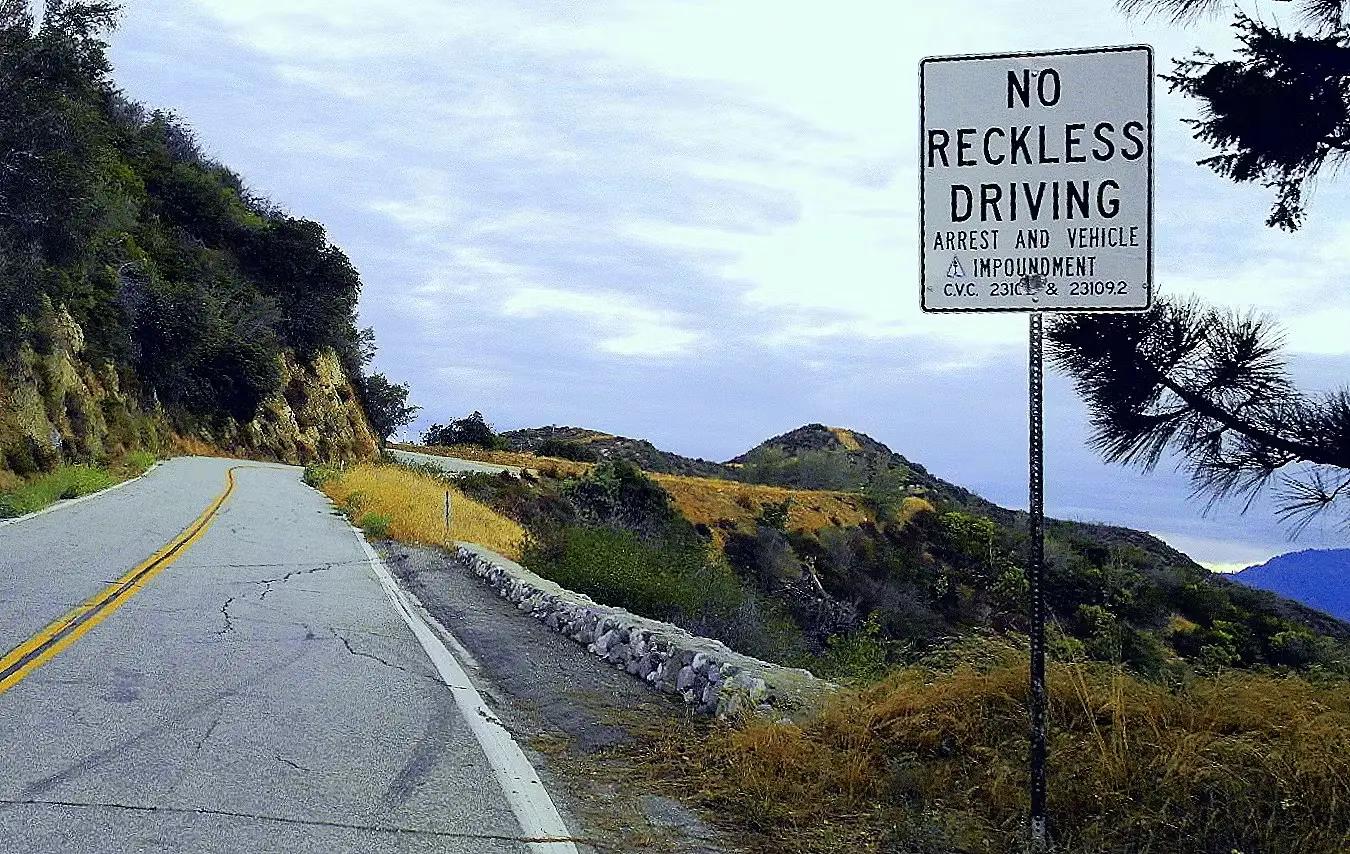
Reckless. It sounds sexy. But there is nothing sexy or fun about reckless driving. It is risky and dangerous - for you, other drivers, and pedestrians. But enough of the public service announcement - you aren't here for that, and probably would prefer to know more about reckless driving laws and their consequences.
Fair enough. Reckless driving is more than just being a little careless. It is driving that shows a conscious disregard for the safety of those around you. In more concrete terms, it typically means you were going really, really fast - far beyond the speed limit, in fact. Reckless driving may also be brought as a charge against those who weave through traffic, blow through stop signs or traffic lights, or tailgate. And in a somewhat surprising twist of the law, reckless driving also may involve those who are tipsy and those with borderline DUI cases who accept a plea bargain - though if you think about it, driving under the influence is, by definition, pretty reckless.
With such a broad spectrum of conduct bundled into a single offense, the penalties for reckless driving, as you would expect, vary greatly by local law and by the facts of the offense. You may face some jail time (a few days for first-timers, up to more than a year for repeat offenders and in cases where someone is seriously hurt or killed), a fine is almost guaranteed, and your insurance rates will likely skyrocket - assuming you still have a license at all.
What is reckless driving?
If you want to know how reckless driving is defined in your state or city, you'll have to turn to the vehicle code and perhaps criminal law statutes as well, though Wikipedia has a pretty insane breakdown of every single state. You obviously don’t want to read about all 50 states, plus some major cities and districts that have their own laws, like Washington D.C., but we can turn to some of the major areas as examples:
- California: One who “drives a vehicle upon a highway [or in a parking garage] in willful or wanton disregard for the safety of persons or property” is guilty of the offense of reckless driving. California also has a “Baby DUI” statute, also known as “wet reckless” for driving under the influence plea bargains. While a prosecutor may not charge you initially with a “wet reckless” offense, it carries fewer penalties than a regular DUI charge and can be offered as a plea bargain in some cases.
- New York State: Reckless driving is defined as “driving or using any motor vehicle … in a manner which unreasonably interferes with the free and proper use of the public highway, or unreasonably endangers users of the public highway.”
- Kansas: Similar to California, Kansas defines reckless driving as “willful or wanton disregard for the safety of persons or property” while driving.
What is not reckless driving? Exceeding the speed limit by a small amount, such as going 36 in a 25, is probably not reckless driving. Nor is eating a cheeseburger while cruising an empty freeway. However, eating a cheeseburger while intoxicated, while driving your car through foggy mountains in a Ronald McDonald-meets-Bob Ross scene, while traveling at twice the speed limit, is almost certainly reckless driving.
You'll notice that there is a lot of gray area in between those extremes, which is where lawyers make their living. While prosecutors are evil and quick to charge defendants with the most severe offenses they can conjure up, having an aggressive defense lawyer on your side will hopefully help you to get a reckless charge reduced and move on with your life.
Drunk Driving as Reckless Driving
For most people, and in most states, drunk driving is charged under its own laws: the regular DUI laws that prohibit driving with a blood-alcohol level of 0.08 or more, or driving while impaired by any amount of alcohol or drugs. But in some states, you can be convicted of reckless driving as an alternative to a DUI charge, typically as part of a “deal” offered by the state to first-time offenders.
As mentioned above, California is an example of one of those states. Prosecutors have the option of offering first-time offenders who plead guilty or “no contest” a lesser sentence under the “wet reckless” charge. This is often referred to as a “baby DUI.” In most situations, the penalty can be nearly as severe as a regular first-time offender DUI charge - the difference is essentially a reduced fine and no mandatory few days of jail time or work release. The conviction will likely count as a regular DUI if the driver is convicted of future DUIs, meaning subsequent convictions will carry steep penalties. License suspensions, alcohol education classes, and an ignition interlock will probably still be required as well. As far as deals go, it isn’t much, but consult with your attorney before accepting or rejecting it, as it may be the best deal you can get.
For extremely weak or borderline DUI cases, and where the accused is especially sympathetic (a first-timer, no other record, perhaps a clean driving record as well), a prosecutor in California and in many other states may offer ordinary reckless driving as a plea bargain. This is a much better deal: it is not “priorable” as a DUI, which means future DUI convictions won’t lead to repeat offender penalties. It carries less or no jail time, a smaller fine, and may not require alcohol education courses or ignition interlock devices in jurisdictions where those are required.
Keep in mind that, for repeat offenders, or if someone was injured, the drunk driving led to an accident, or if the driver had an extremely high blood-alcohol level, wet and dry reckless deals are very unlikely. The only way a reckless deal will be offered in these cases is if the prosecutor has an extremely weak case and is looking for an easy conviction through a plea - in which case fighting at trial may be a better option. Again, speak to an attorney before making any of these calls.
Is reckless driving a felony?
You've probably already guessed what we are going to say next: It depends on your state and the facts of your offense. It is possible in some states for reckless driving to be charged as a felony. For example:
- Minnesota: Driving on a road, in a parking facility, or a frozen lake (thank you, Minnesota - never change) in a willful or wanton disregard for the safety of others, leading to the serious impairment of a bodily function of another person or their death, is a felony.
- Rhode Island: A second or subsequent conviction for drag racing is a felony under this state’s reckless driving laws.
- Virginia: This legendarily draconian state for drivers has more than a dozen variants of reckless driving defined by law. Examples include “passing two vehicles abreast” and “exceeding 80 miles per hour.” Any of Virginia’s reckless driving variants can be brought as a felony if someone is seriously injured.
If your reckless driving charge is brought as a felony, you, more than any other traffic offense defendant, really need an attorney. The penalties for a felony typically include a minimum of a year in jail or prison, massive fines, and it is very possible that you will not have a driver's license for the foreseeable future. There can also be collateral consequences, such as losing the right to vote or own a firearm, and being ineligible to practice certain occupations, such as being a lawyer.
Reckless driving by speeding.
Probably the most common reckless driving charge involves exceeding the speed limit by an egregious amount. Of course, that is itself a grey area. Virginia, while home of some of the most enticing Blue Ridge Mountain scenery and highways, is downright draconian when it comes to speeding. According to the law in Virginia, their state police can bring a reckless driving charge if a driver exceeds 80 miles per hour, even if the speed limit is already 70, which it is in many rural areas of the state. That's right: going a mere 10 miles per hour over the speed limit is “reckless” on those freeways, while going 20 miles per hour over the limit anywhere else in the state will qualify. As a bonus, reckless driving can mean a ton of points on your license in Virginia, plus a possible criminal record.
In other states, the amount you have to go over the speed limit in order to get a reckless driving charge varies greatly, while some states don’t set a number at all - it’s all a matter of context: the roads, traffic, speed limit, and weather can all be arguments for or against a reckless charge.
A related speeding scenario, which litters the laws and vehicle codes of most states, is reckless driving in the form of street racing - referred to as “drag racing” or “exhibition of speed” at times. Although the heyday of illegal street racing and car modding culture has passed now (or at least is not a current fad), perhaps as a result of Fast and Furious movies pivoting from neighborhood street racing to superhero movies, you still regularly hear about accidents that result from a couple of irresponsible teenagers lining up their daddies’ V8s and flooring it from stop light to stop light. “I live my life a quarter mile at a time,” right?
Though most of us have tapped that pedal a little hard from time to time, doing so on a public street or parking garage (Tokyo Drift!) in disregard for the safety of others can be considered reckless driving in most states, and is the kind of reckless behavior that could result in injuries to others and, as a result, a possible felony charge for the driver.
Careless Driving Vs Reckless Driving
Sometimes, normal average humans find themselves balancing a double cheeseburger in one hand, and driving stick while maneuvering a steering wheel through Manhattan traffic with the other. Everybody does that, right? Totally normal?
It's admittedly unnecessarily dangerous. And how long would it really take to eat that burger in the parking lot? Sure, those who have an automatic transmission can simply slap it and go (and imagine the picnic one could have while engaging autopilot in a Tesla). But, those of us who are real drivers will continue to insist on rowing our own gears while stuffing our faces. After all, the act of eating while driving is nothing new: ever since the advent of drive-through restaurants and interstate highways, mobile feasts have been a mainstay of Americana. And driving is downright somnolent with an auto - real drivers have three pedals.
So, what happens when that patriotic, stick-shift loving driver shifts down into second gear while rounding a corner and his greasy palm slips off the wheel? And distracted by the bacon cheeseburger that has now fallen onto his lap, he accidentally collides with a parked car or a family of twelve? Was that reckless driving? Or just careless driving?
For the most part, the line between careless driving and reckless driving is pretty undefined. There are plenty of state laws that specify exact criteria where you have crossed the line into reckless driving, such as the aforementioned Virginia rule: speeding more than 20 miles per hour over the limit or exceeding 80 miles per hour at any point. But, as you’ve now gathered, reckless driving extends far beyond just speeding in most states and includes any scenario in which you are driving in such an unsafe manner that you are consciously disregarding the very real possibility that you may hurt someone.
Does a cheeseburger feast count? Probably not. But that's the beauty of being a prosecutor: they can bring whatever charges they feel are appropriate given the facts. And should you be facing the business end of a prosecutor’s metaphorical shotgun, and the state decides to make an example out of you by bringing reckless driving charges for doing something stupid like feasting while driving, your best defense is to get an actual attorney to fight back. Maybe, with help, that prosecutor will see the light and reduce your charges to a mere ticket.
The Real Reckless Driving Penalties
A lot of us get traffic tickets, pay them, and move on. Maybe we get really smart and try a brilliant app that allows makes it easy to connect with a local attorney to fight a ticket with few taps and a picture of the ticket. This is the point where we get really serious and point out what should be obvious: reckless driving is an actual crime, with penalties far more severe than a regular “ticket.”
Got that? A speeding ticket is a mere infraction in most places: it won’t go on your criminal record, may not even go on your driving record (New York City speeding camera tickets, for example, do not go on your record), and the consequences can be limited to the cost of the ticket and raised insurance premiums. Maybe, if you get enough tickets, you’ll end up with a suspended license. Bad, but not a life-changer.
Reckless driving is an actual crime. As a misdemeanor offense (the less serious type of crime), it may carry a few days in jail or a substantial fine, but it can also stay on your record for employers to see. Your license may be suspended immediately, and even if it is not, in the majority of states where “points” are tracked on your license, it will mean a lot of points - at least if you look at the statutes:
- Six points are accrued in Virginia, compared to two points for a normal speeding ticket. Accrue eighteen points in one year or twenty-four points in two years and your license will be suspended.
- Two points are accrued in California, compared to one for a regular speeding ticket. Accrue four points in a year, six points in two years, or eight points in three years, and your license will be suspended.
- In New York, reckless driving is five points. Accrue a mere six points in eighteen months and you’ll have to pay a driver responsibility assessment fee (a $100/year tax for three years, plus an additional $25/year per point over six points). Accrue 11 points in eighteen months and your license will be revoked.
Even if you don’t get another ticket, and avoid a responsibility fee or suspension, your insurance rates will go up, usually significantly. To avoid the insurance hike you can obviously fight the reckless driving charge in court (win and you get no points) or depending on your state, you may be able to take a traffic safety course to remove the points from your record. The traffic course option may be available to everyone with a ticket, or your attorney may have to negotiate for the option in court - check with your local laws and attorney for details.
And, as we’ve mentioned, reckless driving can also be a felony. If you are hit with a felony charge and convicted, the penalty can be severe: lengthy prison sentences and heavy fines to start, with severe curtailment of your rights after release (such as your right to vote, own a firearm, serve on a jury, and much more) plus diminished job prospects when employers check your record.
The First Step is to Talk to a Lawyer
As you can see, reckless driving isn’t sexy. It’s downright scary if you are the accused. The consequences of a conviction go far beyond the initial sentence, which can include jail or (if the case is brought as a felony) prison time, plus a fine. There’s also possible points on your driver’s record, a license suspension or revocation, insurance hikes, and a conviction on your criminal record that will haunt you for years to come when you apply for jobs or professional licensure.
With all that said, the first thing you need to do if you have been accused of reckless driving is to talk to a lawyer. Most offer free consultations and can give you an idea of what you are facing. Here at Off The Record, we may be able to help too: just download our app (for iOS) or visit our website, tap a few buttons, snap a picture of the ticket, and you’re on your way to being connected to a lawyer near you.
This information on this site is provided solely for informational purposes. It is not legal advice. Off The Record is not a law firm, does not provide legal services, and is not a lawyer referral service. The attorney listings on the site are paid attorney advertisements. Off the Record has not evaluated this content for accuracy, completeness, or changes in law. No representation is made here about your specific rights. Off The Record is not a substitute for an attorney or a law firm. Legal advice can only be provided by a licensed lawyer.

 Off the Record