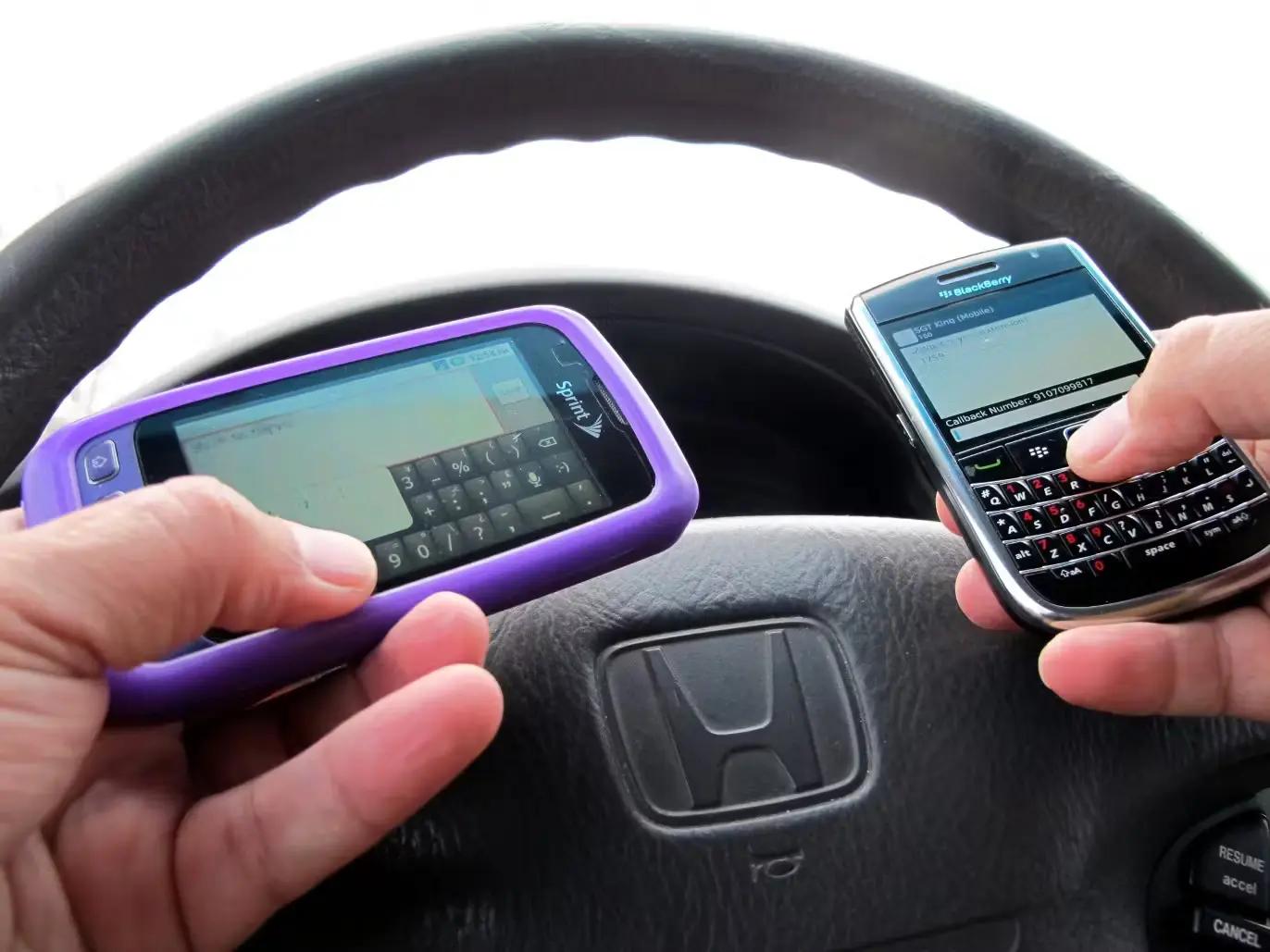
The worst people, the most imbecillic individuals, are the video chatters. Texting while driving, sure, it’s pretty bad. But the folks who video chat while driving are on another level - they insist on Facetiming while driving. They can’t even see the video - they’re too busy scanning the road (we hope) for potential deathtraps (like themselves). But they still insist on video chatting. Some are celebrities recording inspirational videos for social media, while others are just babbling relatives who can’t put their phones down for five minutes.
So it’s more than texting. It’s gotten far worse than just tapping your phone keypad a dozen times to get an “i” and another fifteen to get a “luv u” spelled out. People are using their smartphones - which do as much as a desktop computer these days - while driving. The blanket term applied to this behavior is “distracted driving,” which today, seems like an understatement. It’s also a moving violation - a mere ticket meant to discourage the behavior.
Do the laws work? And is this really a dangerous problem worth legislating?
Dangers of Texting And Driving
Here’s one danger: you can’t see the darn road if you’re texting. Put the phone down!
Okay, you’re not convinced. Here’s a hard truth about humans: we all think we’re excellent multi-taskers, but in reality, we actually suck at it - multitasking just means we’re doing multiple things poorly. According to the American Psychological Association, studies have shown that driving while distracted is pretty much tantamount to driving while over the legal limit of alcohol in terms of impairment. Pokemon Go makes you drive like a drunk, in other words.
Maybe you have a hands-free device. Surely that’s okay, right? It depends on what you are doing. Listening to audio books and music, per the APA, has little to no harmful effects on your attention span (so long as you stay awake - don’t listen to Clarence Thomas’s autobiography). On the other hand, talking slows your reaction times by as much as thirty percent - imagine how much more impaired you’d be if that conversation was via text or video chat.
Here’s the real kicker, and perhaps a good objection to current “hands-free” laws: the studies cited by the APA showed no difference in reaction times and driving performance between hand-held and hands-free use of a device. It’s the mental and conversational part, in other words, that distracts you, rather than the physical holding of a device. That line of reasoning won’t get you out of a ticket when you get pulled over, but it may just save your life.
Texting & Driving Statistics
For all the math people: According to the National Highway Traffic Safety Administration, 3,166 people were killed by distracted driving in 2017 alone, accounting for 8.5 percent of total fatalities for the year. Compare that with the data on drunk driving: 10,908 people died in alcohol-impaired crashes in 2017.
Drunk driving gets the press and the severe criminal charges, while most people consider texting and driving to be a mere nuisance worthy of a ticket. More than 1,000 preventable injuries per day are the result of distracted driving, per the FCC. Is that many injuries, and thousands of preventable deaths, really just a nuisance?
If that doesn’t get your attention, here’s a bigger statistic from studies cited in Goldstein’s Cognitive Psychology: 80% of crashes and 67% of near crashes were the result of inattentive focus three seconds beforehand. Remember, other psychological studies indicate that it isn’t the physical use of the device that causes the distraction - it’s the mental aspect, and hand-free chatting away or voice texting through Siri is probably just as dangerous as quickly tapping away on a keyboard.
Texting and Driving Laws
Today feels like a half-full kind of day, so we’ll start with the positive take: lawmakers have done something about texting while driving. Nearly all states specifically prohibit texting while driving and consider it a moving violation. A moving violation is an illegal activity committed while your vehicle is in motion - hence, the name. Typically, a moving violation means a ticket and, depending on local law, points on your driver’s license.
On the other, less half-full hand, if you read any of the above psychological study notes, you’ll understand that texting itself, and more broadly, physical device usage, isn’t the sole culprit for distracted driving - any active usage, even hands-free, that requires your attention is a problem.
In short, a texting ban won’t get it done. It’s a half-measure. The Governors’ Highway Safety Association (GHSA) notes that thirty-six states and D.C. prohibit all cell phone use by novice drivers, and many of those states also ban cell phone use by school bus drivers. That’s certainly a step towards a law that will actually address the problem, though it would be nice to see drivers of all ages banned from mobile device usage. (Except maybe GPS. Who can go anywhere these days without Google Maps or Waze helping us to get where we’re going.) Instead, forty-eight states stopped short at banning texting, while only fifteen states ban hand-held mobile device usage for all age groups.
This begs the question: which states haven’t even taken the minimal step of banning texting? Montana, known also as one of the most lenient states for drunk drivers, has no text messaging ban. Missouri has a ban, but it only applies to those 21 years of age or under. Perhaps it is better to do nothing than to aim your sights at the wrong problem: texting is but one form of distracted driving after all, but “texting while driving” seems to be the biggest scapegoat.
If your state is one of the nearly all that do ban texting or mobile device usage while the vehicle is in motion, another big distinction to look into in your state is whether texting and handheld device usage is a primary or secondary offense. If it is a primary law, the police can pull you over and ticket you for texting or using your phone. If it is secondary, they must have some other reason to pull you over, such as speeding, meaning the texting or handheld device usage ticket is just a bonus ticket from the police officer. GHSA notes that all but three states that have a texting ban make it a primary offense, so the law is pretty much the same in nearly all states: cops can pull you over and ticket you for texting. If you’re curious about your state’s law, GHSA has a table of each state’s laws and peculiarities (like age limits).
And more fine print: while the above rules are state rules, and there are no federal laws regarding texting while driving, there may also be city, county, or municipality rules. Some states have special preemption laws that prohibit local governments from taking things further - like Florida, Mississippi and South Carolina - while many other states do not.
Your next question, after reading all that, is probably about the penalties. And as always, it varies greatly by state. Here are a few examples, from least severe to most:
- Montana: there is no prohibition on texting while driving
- California: $20 for your first mistake, $50 thereafter
- Pennsylvania: $50 fine.
- Minnesota: up to a $300 fine
- Alaska: up to a $500 fine
- Utah: up to three months in jail and up to a $750 fine.
Alaska is a fascinating study of extreme laws and how they probably don’t work. Until late 2016, it was a criminal offense - a Class A misdemeanor - to text and drive in Alaska. That’s in the same neighborhood as a DUI offense. Drivers faced up to a $10,000 fine and a year in jail for texting. Compare that with California’s $20 fine. Fortunately or not, Alaska’s drivers have less to fear now that the law was tweaked: so long as nobody is injured or killed, texting carries a max penalty of $500 and no jail time. If someone is injured or killed, the law stayed the same: a felony charge that carries up to $50,000 in fines and five years in prison (more if the injury is serious or death occurs).
The last point to consider on penalties for texting and driving are license points. Whether or not you will accrue points on your license due to a texting ticket varies based on your state. While some states don't prohibit texting while driving, and some treated as even more mild than a littering ticket, other states will assess points: New York, for example, will assess five points for a single texting offense. Eleven points in eighteen months will result in a license suspension. A mere six points, so texting and any other violation whatsoever, will result in a driver responsibility assessment fee. This is basically a tax on "dangerous" drivers due every year for three years.
And of course, we would be remiss not to mention insurance rates. Anytime you get points on your license, your insurance company will find out and jack up your rates.
Distracted Driving Facts - Texting While Driving
An average of nine people per day die in accidents caused by distracted drivers. That’s nine very preventable deaths. And while, in a recent survey, ninety-six percent of drivers said that they were safe drivers, fifty-six percent admitted to using their phones while driving. How many actually used their phones? Ninety-six percent did, at least once, in the past thirty days. (The survey was done through an app that tracked phone text and call usage.)
In other words, everyone uses their phone while driving. It’s no wonder then that traffic fatalities and distracted driving accidents are on the rise - traffic fatalities from all causes rose at the highest rate we’ve seen in fifty years, per recent figures, and distracted driving makes up ten percent of those deaths.
And, at the risk of being repetitive: it’s entirely preventable. For parents, these facts and statistics are something that you need to discuss with your teens. Driver distraction is responsible for fifty-eight percent of teen crashes. Compare that with accidents involving all ages, where distraction is responsible for only a quarter of accidents. Clearly, teenagers are more at risk when allowing distractions to take their focus off the road. Car accidents are the leading cause of death for teens, and while we’ve seen teen drunk driving rates decrease, fatal accident rates overall have not - distracted driving is likely erasing any progress we’ve made on the DUI front, in other words.
It may also help to look at your technology in the car as well. Modern infotainment systems in cars can be distracting on their own - many cars now come with 10-inch tablets in the center console. But they can be a blessing as well: Apple’s CarPlay and Android’s Android Auto are both stripped down interfaces that appear on the stereo when a phone is connected, leaving the driver with fewer distractions, no ability to attempt to type texts on a keyboard, and only a few big icons for music, navigation, and phone calls.
Consider these apps and devices to help too:
- Cellcontrol: The most hardcore of devices, Cellcontrol starts with a device inserted under the dashboard and an accompanying app on your teen’s smartphone that prevents sending or receiving texts while driving. It also prevents other phone features, such as email or camera usage, while the car is in motion. It is available for both Android and iOS.
- Drive Safe Mode This is another snooping app that teens will object to and parents will feel good about. It also blocks texting and emailing while driving, and it will notify a parent if a phone is used or the app is disabled while the car is in motion. It is also available for both Android and iOS.
- DriveMode: DriveMode, by AT&T, is part of their “It Can Wait” campaign. Like the others, it is an app that blocks incoming texts and calls while driving. Incoming texts will receive auto-responses indicating that the person is driving and is unable to respond at the moment. The app automatically activates when it sees your speed has reached 15 MPH and deactivates after 2-3 minutes when your speed drops below 15 MPH.This app is for both iOS and Android.
- OnMyWay: Perhaps the most brilliant, and certainly the most positive, of the anti-texting apps is OnMyWay. Instead of punishing or snooping on your child’s phone use - if it saves your child’s life, snooping is okay, but should probably be a last resort - this app uses positive reinforcement, also known as bribery. The app will pay you for signing up. It will pay you more for each mile you drive with your phone locked. Refer friends and get even more. It won’t make your teen rich, but it may give them a little extra gas money and won’t send the message that you don’t trust them. (Also, it is not just for teens - you can use it too to replenish your Starbucks fund or whatever else you need pocket change for.) It’s available for both Android and iOS.
Finally, be aware of apps that do the opposite - they may implicitly encourage phone use while driving. Snapchat, for instance, displays one’s speed on some photo filters, Waze encourages “passengers” in cars to report traffic, speed traps, accidents, and other hazards - how many drivers become hazards themselves while ignoring the app’s futile request to limit such reporting to passengers. And, of course, there are location-based games like Pokemon Go and Harry Potter, both of which reward you for going out and visiting locations - you can hit up a lot more Pokestops in a car than you can on foot
Stop Texting While You're Driving
Maybe the most maddening thing about texting while driving, and especially the injuries and accidents that result, is that it is extremely preventable in this day and age. Most of this article was drafted through voice typing. And believe it or not, there weren't that many typos. Certainly, the first draft of this article would have been comprehensible enough as a text message to get the point across. Learn how to use voice typing (the microphone button on your keyboard) on your Android or iOS device if you must send messages while driving. Or try saying, “Hey Siri” or “Okay, Google,” then “Send a text to [recipient] [your message].”
The truth is, it can probably wait. Using your voice to text, to carry on a conversation, or to launch your navigation and music may feel safer, and it may comply with hands free laws, but again, the mental distraction is the bigger issue and cause of accidents than physical typing, though laws mainly address physical device usage only. Voice typing may help you skip the ticket, but it won’t save your life.
If you have been the unlucky recipient of a texting while driving ticket, the answer isn't just to pay it and move on. We don’t advocate texting while driving - or any phone usage while driving - but we also don’t advise rolling over when a cop gives you a ticket. (Especially since ticketing has proven to have very little deterrent value.) With penalties that can include points on your license, license suspensions, hiked insurance premiums, and more, it may be worth fighting the ticket even if the amount on the face of the ticket seems trivial. Here at Off the Record, we make fighting a ticket as simple as a few taps in our app or on our website.
Getting started is easy: Take a picture of the ticket and we will connect you with a lawyer in your area that can help you. We offer a money back guarantee, so if you do not receive a positive outcome on your challenge to the ticket, you will get your fee refunded. What are your chances of successfully beating the ticket? Let's just say that with a money back guarantee, we wouldn't be in business long if our lawyers didn't win.
This information on this site is provided solely for informational purposes. It is not legal advice. Off The Record is not a law firm, does not provide legal services, and is not a lawyer referral service. The attorney listings on the site are paid attorney advertisements. Off the Record has not evaluated this content for accuracy, completeness, or changes in law. No representation is made here about your specific rights. Off The Record is not a substitute for an attorney or a law firm. Legal advice can only be provided by a licensed lawyer.
Image credit: frankieleon CC BY 2.0

 Off the Record