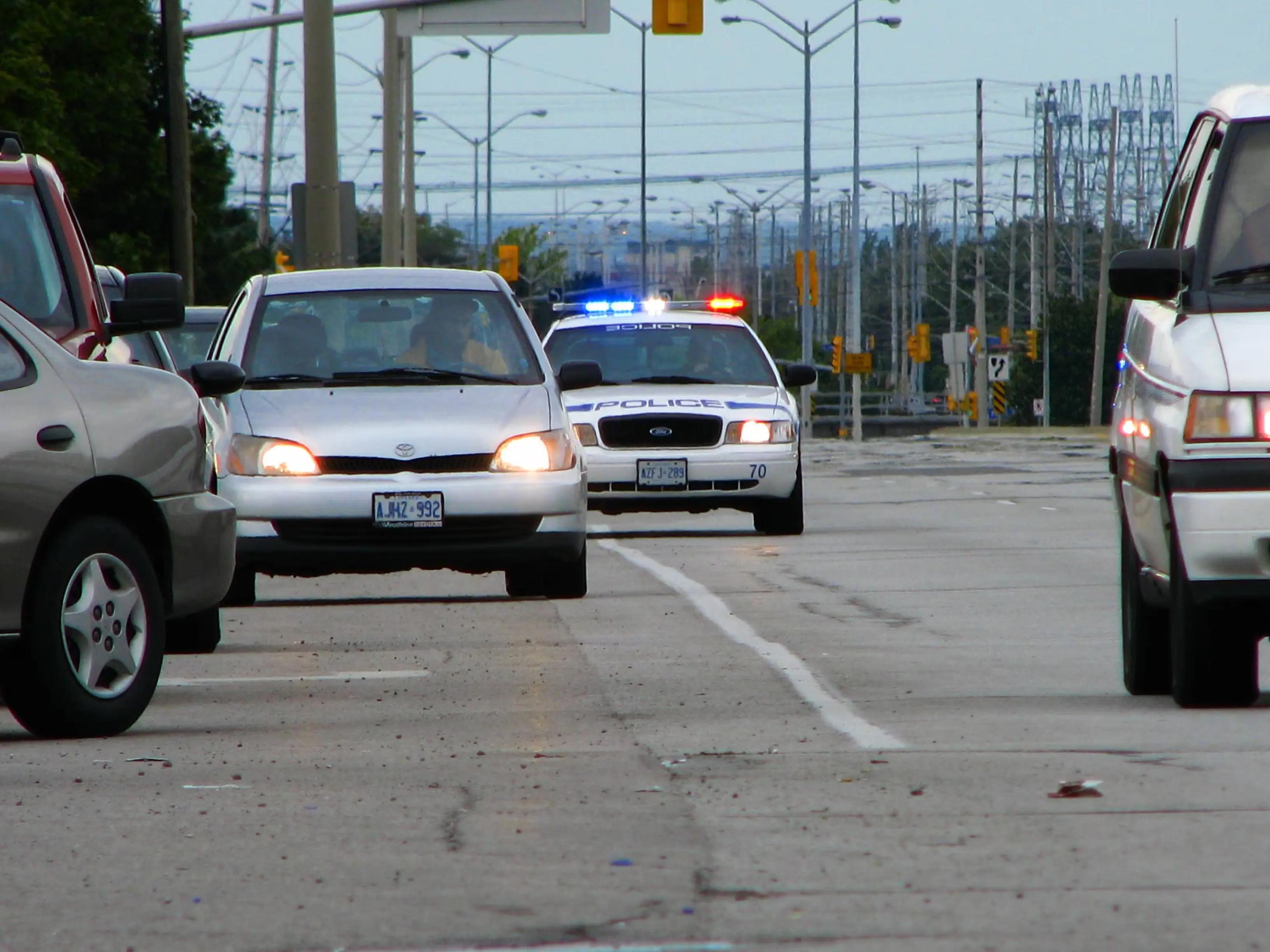
One minute you’re tapping your fingers on the steering wheel to the beat of your favorite song. The next thing you know, the beat that’s got your attention is that of your heart, racing way faster than normal, triggered by red and blue lights flashing in your rearview mirror. Yes, you’re getting pulled over.
Remember that scene in the movie Taken when Liam Neeson’s character (an ex-CIA operative) is on the phone with his daughter right before she gets abducted in a Paris apartment? He implores her to “stay focused” as the bad guys arrive. He tells her that what she does next “is key” to her survival, and that she must “concentrate.” The stakes are obviously different in a traffic stop, but the same principles apply when the police are pulling you over. Don’t panic. Stay calm. Remain focused. And don’t worry—we’ve got you covered. In this article, we address what to do when pulled over.
What’s at Stake When You Get Pulled Over by the Police
Police pull motorists over for many reasons. It may be for something as simple as a malfunctioning taillight or as serious as suspected drunk driving. Regardless, it’s a nerve-wracking experience involving an imbalance of power between the parties—the police officer who has the power to ticket you, or worse, and an individual who may not know why she got stopped in the first place.
And, yes, the stakes are high. If ticketed for speeding, you’ll be fined, receive points on your driving record, and your auto insurance rates will likely rise. A traffic stop leading to a DUI arrest will have much graver and more costly consequences, from the near certainty of restrictions on (or outright suspension of) your driving privileges, to the possibility of incarceration and steep fines.
A simple traffic stop can also be a precursor to bigger problems. A police officer needs “probable cause” to pull you over and speeding or rolling through a stop sign is cause enough. Once you’re stopped, a driver can be at risk of having other criminal activity discovered, such as the presence of illegal drugs or an unlicensed firearm in the car.
While the risks are real, there are steps every driver can and should take to limit their potential liability when they get pulled over.
What To Do When Pulled Over For Any Traffic Violation
Once it’s clear that you’re getting pulled over, take a deep breath and clear your head. Certainly, don’t panic. Slow down and signal that you’re turning to the right so the officer knows you’re in the process of pulling over. Find a safe place to park. The officer will appreciate you stopping in a well-lit area away from traffic that gives him the opportunity to safely exit his vehicle. The more you can put the officer at ease in the initial moments of a traffic stop the better.
After you’ve stopped, turn off your engine and roll down your window. It’s okay to only partially roll your window down at this point, particularly before you’re certain you’re dealing with a legitimate officer. If it’s dark out, turn on your car’s interior lights so the officer can assess the situation without shining a Maglite in your face.
Remain still, calm, and keep your hands on the steering wheel as the officer approaches your vehicle. Under no circumstances should you get out of the car unless ordered to by the officer.
What happens next depends, to a large extent, on why you’re getting pulled over. Read on, because what you do and say after getting stopped by the police can have a big impact on (1) whether the officer lets you off with a warning, and (2) your likelihood of success in contesting an infraction if you get cited.
What To Do When Pulled Over For Speeding
As long as you’re not “fast and furiously” drag racing through the streets like Vin Diesel, there’s a chance an officer will give you a pass even if you are, in fact, speeding. Here are a few ways to increase the prospect of catching a break.
- Speak When Spoken To. First, know that you don’t have to say anything at all. As in all interactions with law enforcement, when you get pulled over for speeding you have the right to remain silent. Sitting mum, however, is unlikely to earn you a free pass. Instead, let the officer do the talking, and then respond as appropriate. You’re not likely to be let off if you immediately launch into a diatribe about being late for an appointment.
- Be Polite. Show respect and be friendly to the officer (without disingenuously overdoing it). Remain calm and relaxed. Address him or her as “officer.” Never try to pull rank with a “Do you know who I am?” comment.
- Have Your Paperwork Easily Accessible. If you want the officer to believe you’re a responsible citizen worthy of a free pass, have your license, registration, and insurance organized, up-to-date, and easily accessible. You don’t need to provide this information until it’s requested (it almost certainly will be), but it doesn’t look great if you’re fumbling around in the glove compartment while the officer stands waiting.
There’s a chance you’ll get off with a warning, but let’s get real. In most cases, if you get pulled over for speeding, you’re getting a ticket. And if you want to preserve your ability to contest the alleged driving violation, there is one priority to keep in mind that trumps all others: Don’t admit to anything!
Don’t Admit To Speeding When Pulled Over
It bears repeating: When you get pulled over for speeding, let the officer initiate the conversation. And when you do respond, choose your words carefully. As you’ve likely heard many times before in movies and television shows, anything you say in an encounter with the police “can and will be used against you.” Officers are taught to induce confessions of guilt by acting as if they’re interested in your version of the events.
It may seem like robust cooperation is the surest route to getting off with a warning, but it’s a risky move because you may say something incriminating that forecloses any opportunity to fight a speeding ticket. If the officer says, “Do you know why I pulled you over?” or “Do you know how fast you were driving?,” simply answer “no.” Don’t apologize. Don’t offer an excuse. Just confirm that you don’t know why you were pulled over.
There are things you are required to say or provide to an officer after getting pulled over. For example, the officer must be able to identify you. There’s no getting around having to prove that your vehicle is properly registered, and, in most states, insured. But you don’t have to—indeed, should not—admit guilt. Be polite. Don’t be argumentative. And when asked if you know why you were pulled over: Just say “no.”
What To Do When Pulled Over For DUI
It’s one thing to get stopped for speeding, but if you had a few drinks before getting behind the wheel then the potential consequences of getting pulled over can be a lot higher. It’s critical, therefore, to know what to do when pulled over for DUI (driving under the influence).
Police officers take DUI stops seriously. After all, statistics show that almost 30 people die in drunk-driving crashes every day—that’s over 10,000 people per year. Accordingly, in all 50 states it’s illegal to drive with a blood alcohol level of .08 grams of alcohol per deciliter of blood. It only takes a few drinks for men and women to reach the .08 threshold, so don’t assume that merely having “a couple of beers” before driving will keep you safe if you get pulled over.
The actions you take both during and after a DUI stop can be the difference between getting off and getting convicted. A drunk driving conviction is costly, both in terms of its impact on your financial resources and your personal freedom. The best advice, of course, is to never drive after drinking. But if you do slip up, and find yourself behind the wheel after consuming alcohol, here’s what to do when pulled over for DUI.
- Remain As Calm As Possible. Your behavior during a DUI stop will be noted in an officer’s police report, and these days it’s likely to be recorded on video through a dashboard and/or body camera, as well. Don’t add to your troubles by being hostile during a DUI stop. You’ll have enough evidence to fight if cited for DUI. Don’t compound your problems with aberrant or argumentative behavior that a prosecutor can point to as proof you were intoxicated.
- Don’t Incriminate Yourself. As in the case of a speeding, when you get pulled over for DUI, avoid answering questions in a way that admits guilt. At this point, you’re being detained—you’re not under arrest—and you’re completely within your rights to politely decline to answer when the officer asks, “Have you been drinking?”
Should I Refuse A Field Sobriety Test When Pulled Over For DUI?
If you get pulled over and a police officer smells alcohol or marijuana, then there’s a strong likelihood that you will be asked to step out of the car to perform field sobriety tests. If you fail these tests—you can’t walk in a straight line, balance on one foot, or recite the alphabet in reverse—the odds of you getting arrested for DUI greatly increase. And, again, if you’re on camera unable to maintain your balance or slurring your speech, you can bet the prosecutor will use that evidence against you at trial.
It’s important to keep in mind, therefore, that you can refuse a sobriety test and the officer cannot force you to take one. But such a refusal is not without consequences, and the extent of those consequences vary by state. For example, in Michigan, the fact that a motorist refused a field sobriety test cannot be used as evidence that the driver was intoxicated at trial. In Washington, the refusal of a field sobriety test can be used against a motorist as evidence of guilt. Not taking a field sobriety test can also lead to the suspension of your driver’s license under a state’s “implied consent” laws.
In summary, there are potential benefits to refusing a field sobriety test, but it depends which state you’re in. In a state such as Michigan, not taking a test can mean there will be less compelling evidence to use against you at trial. Your attorney may also be able to argue that the officer lacked probable cause to arrest you with only “watery eyes and slurred speech” (information included in almost every DUI police report) to go on. However, in many other states the refusal, itself, can be used as evidence of guilt and you may automatically lose your license.
Choose A Breathalyzer Over A Blood Or Urine Test When Pulled Over For DUI
Even if you refuse a field sobriety test, you still may be—and probably will be—arrested for DUI. Allegations of erratic driving, watery eyes, slurred speech, the presence of an open intoxicant, and/or the smell of alcohol or marijuana can be enough. An officer who suspects you may be intoxicated will also likely ask you to take a breathalyzer test.
You can refuse to take a breathalyzer test but doing so is risky. As in the case of refusing a field sobriety test, the penalties differ by state. In most, a refusal results in an automatic 12-month license suspension under “implied consent” laws. And even if you refuse you still may get convicted of DUI based on other evidence. Plus, in many states, such as Illinois, jurisdictions have adopted “no refusal” DUI enforcement initiatives that allow officers to obtain warrants from “on call” judges which can be used to force suspects to submit to a breathalyzer in the field, or blood or urine testing back at the station after an arrest.
Given the alternatives, and because of the ramifications from refusing a test in most states, it’s often best to opt for a breathalyzer test. Breath tests are typically perceived as less reliable, and thus easier for a lawyer to challenge in court.
Don’t Lose Hope If You Get A Ticket
Hopefully you now have some tips that will help keep you out of trouble the next time you get pulled over. But the reality is that, in most situations, if you get stopped by the police you’re going to get cited for some sort of violation. That’s why we focused not only on the best ways to get off with a warning, but also how to put yourself in the best position to fight if you have to go to court.
At Off the Record, we’re here to help. We make it easy to fight traffic tickets. Simply snap a photo of your ticket, answer a few questions, and we’ll match you with an experienced lawyer to handle your ticket. Best of all, if you don’t win, you don’t have to pay. It’s that easy—and it’s worth it to avoid the steep fines and other risks that can result from getting pulled over.

 Off the Record